Why Is Your Pole Barn in Carpentersville, IL Too Hot in Summer and Cold in Winter?
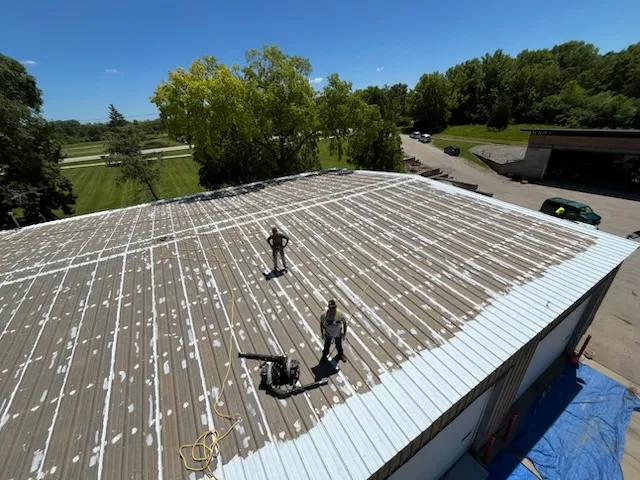
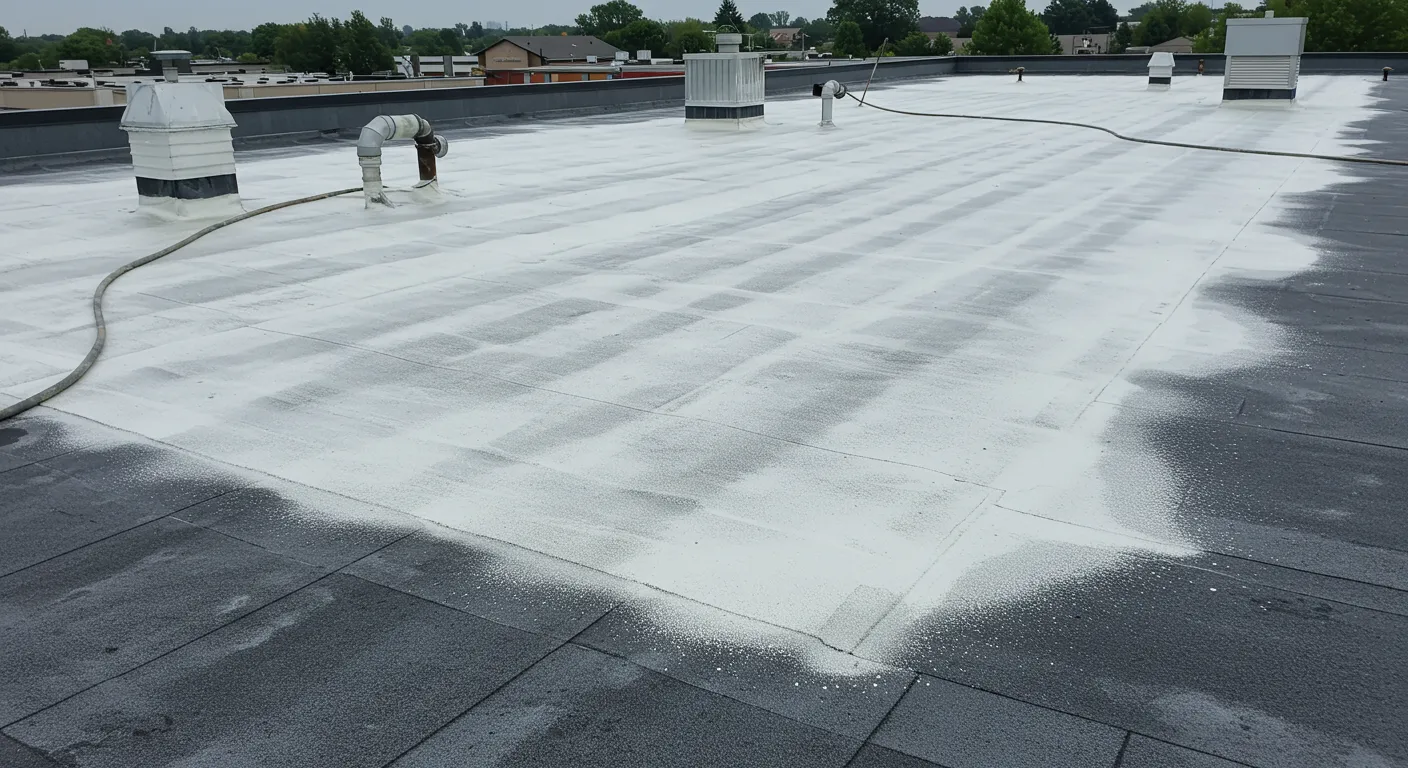
Pole barn insulation services can help address the extreme temperature swings common in Carpentersville, IL pole barns. Bare steel panels…


If you own a pole barn in Bartlett, Illinois, you already know how brutal our winters can get. Subzero temperatures, biting winds off the prairie, and sticky summer humidity make an uninsulated pole barn miserable to spend time in. Whether you are using yours as a workshop, a home gym, a garage, or even a finished living space, the difference between a building you barely tolerate and one you genuinely enjoy often comes down to one thing: insulation.
But insulating a pole barn is not as straightforward as insulating a traditional stick-built home. The post-frame construction method, metal siding, open ceiling spans, and condensation risks all add layers of complexity that most homeowners do not anticipate. Get it wrong, and you will face rotting wood, rusted metal, mold growth, and astronomical energy bills. Get it right, and you will have a comfortable, energy-efficient space that serves your family for decades.
We have spent years insulating pole barns throughout the Chicago area, and we have seen just about every scenario. We wrote this guide to walk you through the entire process, from understanding why insulation matters for your specific situation in Bartlett to choosing materials, planning your approach, and avoiding the mistakes we see over and over again. By the end, you will have a clear roadmap, whether you plan to tackle some of the work yourself or hire a professional.
A pole barn, or post-frame building, is constructed quite differently from a conventional home. Instead of a continuous foundation and load-bearing stud walls, a pole barn relies on large vertical posts set into the ground or anchored to a concrete slab to support the roof. The walls between those posts are typically non-structural, often consisting of metal panels attached to horizontal girts spaced several feet apart.
This design gives you wide-open interior spaces with no support columns, which is part of why pole barns have become so popular for residential use. But that same design creates real insulation challenges. The wide spacing between framing members means there are large cavities to fill. Metal walls and roofing conduct heat rapidly. And because post-frame construction is often less airtight than standard framing, air infiltration can undermine even the best insulation.
According to ENERGY STAR, the EPA estimates that homeowners can save an average of 15% on heating and cooling costs by air sealing and adding insulation. A study commissioned by the national insulation trade associations found that energy savings ranging from 10 to 45% are achievable by properly air sealing and insulating existing buildings. Those savings matter even more in a pole barn because the starting point is usually so much worse than a conventional home.
Beyond energy savings, insulation directly affects your comfort, protects your building from moisture damage, reduces noise transmission, and can even extend the life of your HVAC equipment by reducing its workload. In a climate like Bartlett’s, where summer temperatures regularly climb into the 90s, and winter wind chills drop below zero, proper insulation is not a luxury. It is a necessity if you want to actually use your pole barn year-round.
Bartlett sits in northern Illinois, which places it firmly in IECC Climate Zone 5 according to the Illinois Energy Efficient Building Code. This distinction matters because the International Energy Conservation Code sets minimum insulation R-values based on climate zone, and Zone 5 is one of the colder regions in the continental United States.
For a pole barn that you are converting to conditioned living or working space, the prescriptive R-value requirements for Climate Zone 5 are:
| Building Area | Minimum R-Value (Zone 5) |
|---|---|
| Ceiling (with attic) | R-49 to R-60 |
| Wood Frame Wall (cavity + sheathing) | R-20 or R-13 + R-5 sheathing |
| Floor over unconditioned space | R-30 |
| Basement Wall | R-15/R-19 |
| Crawl Space Wall | R-15/R-19 |
These numbers represent the minimum code-compliant levels. For a pole barn used as a primary living space, we generally recommend exceeding these minimums where practical, especially in the ceiling, where heat loss is greatest. The Department of Energy’s Guide to Home Insulation provides additional guidance on recommended R-values by zone.
Key Takeaways: Climate Zone Requirements
Not all insulation is created equal, and the best choice depends on your budget, your building’s construction details, how you plan to use the space, and whether you are retrofitting an existing structure or insulating during new construction. Here are the main options and how they perform in pole barn applications.
Fiberglass batts are the most widely recognized insulation type and the most affordable option upfront. They come in pre-cut widths designed to fit between standard framing, and in pole barns, the wide post spacing (often 8 feet) actually works to your advantage because you get long, uninterrupted runs with fewer compression gaps than in a traditional 16-inch-on-center wall.
Fiberglass delivers an R-value of roughly R-3.2 to R-3.8 per inch. Standard 2×4 cavity batts provide about R-13, while 2×6 cavity batts reach R-19 to R-21. For ceiling applications, you can layer batts to reach R-38 or higher.
The downsides are significant for pole barns, though. Fiberglass does not air-seal, so gaps around the edges let drafts through unless you add a separate air barrier. It is also highly susceptible to moisture damage. If condensation forms inside the wall cavity, fiberglass absorbs it, loses its R-value, and can sag or support mold growth. This makes vapor barrier placement absolutely essential.
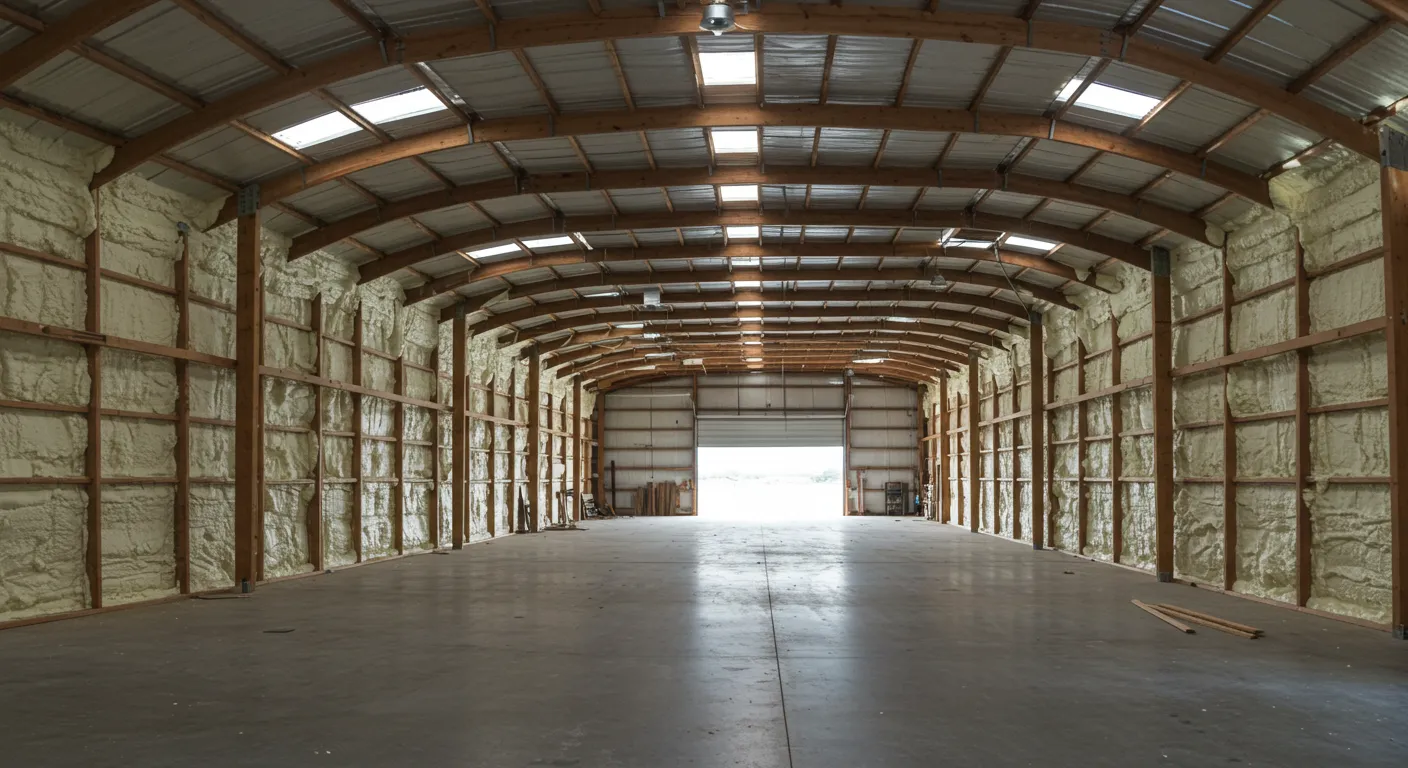
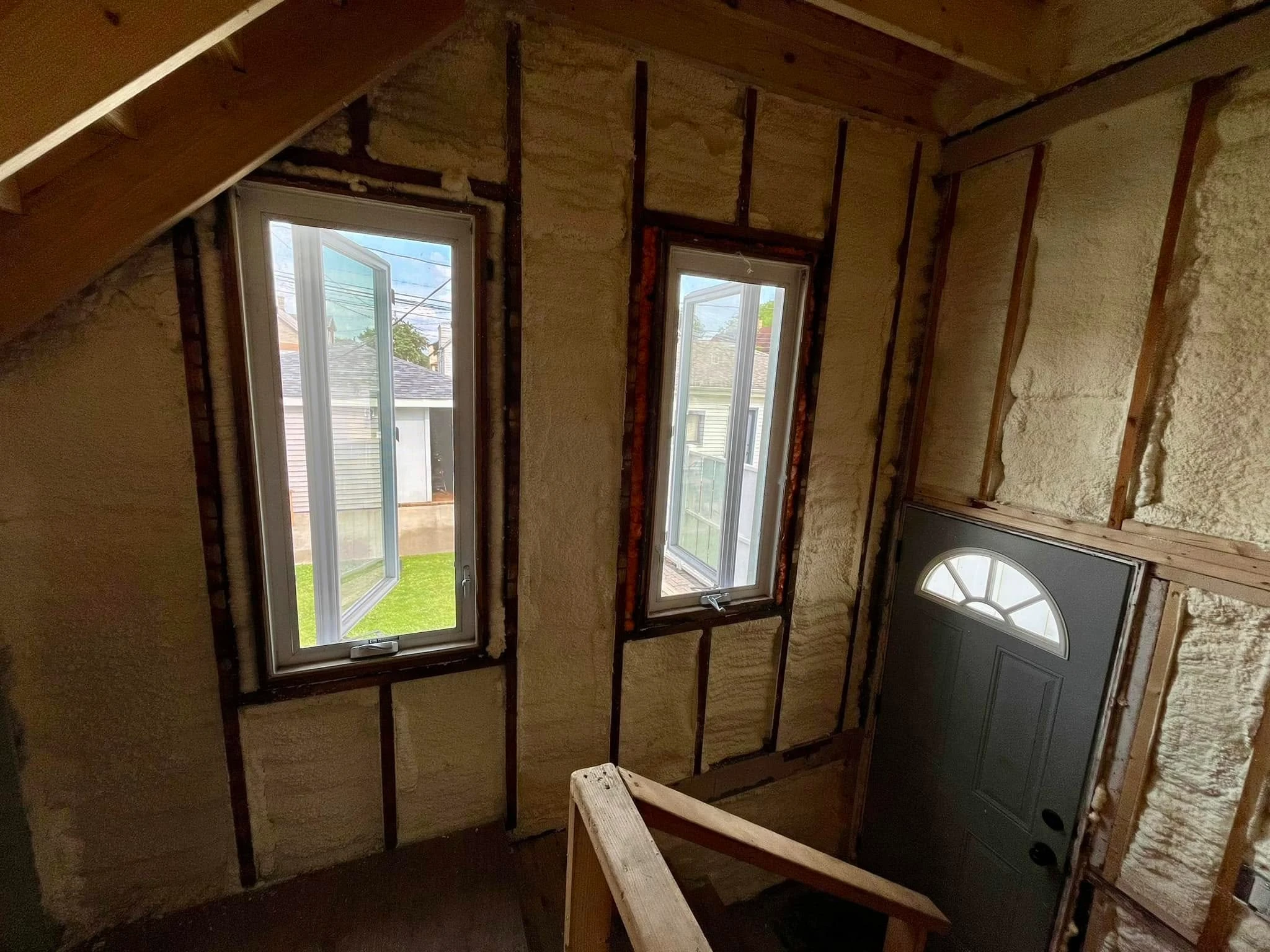
Spray foam is widely considered the gold standard for pole barn insulation, and for good reason. It expands into every crack and gap as it cures, creating an airtight seal that no other material can match. There are two types to consider:
Expert Tip: In our experience, a combination approach often works best for pole barns: 1 to 2 inches of closed-cell spray foam applied directly to the interior face of the metal siding to create a moisture-impermeable air seal, followed by fiberglass or mineral wool batts in the remaining cavity depth to reach your target R-value. This gives you the air-sealing benefits of foam without the cost of filling the entire cavity with it.
Rigid foam boards, including EPS (expanded polystyrene), XPS (extruded polystyrene), and polyiso (polyisocyanurate), offer high R-values per inch and excellent moisture resistance. Polyiso boards provide the highest R-value at roughly R-6.5 per inch for 1-inch-thick boards.
Rigid foam is a popular choice for pole barn walls because it can be cut to fit between girts and serves double duty as both insulation and a continuous air barrier when seams are properly taped. It does not sag, settle, or absorb moisture like fiberglass can. It is also one of the easier materials for a DIY installation, though achieving a proper air seal at all joints requires careful attention to detail.
Blown-in fiberglass, cellulose, or mineral wool is most commonly used in pole barn attics and ceiling cavities where the irregular framing of trusses makes batts difficult to fit properly. Cellulose, made from recycled paper products, delivers roughly R-3.2 to R-3.8 per inch. Blown-in materials conform to every shape and gap, creating a dense, seamless blanket of insulation.
For wall applications, some blown-in products are designed with an adhesive binder that allows them to be installed in open wall cavities and stick in place behind a retaining net or plastic sheeting. This approach can work well in pole barn retrofit situations where removing the exterior metal panels is not practical, but the interior is still open.
| Insulation Type | R-Value Per Inch | Air Sealing | Moisture Resistance | Best For | DIY Friendly |
|---|---|---|---|---|---|
| Fiberglass Batts | R-3.2 to R-3.8 | Poor | Low | Walls and ceilings on a budget | Yes |
| Open-Cell Spray Foam | R-3.5 to R-3.7 | Excellent | Moderate | Wall cavities, irregular spaces | No |
| Closed-Cell Spray Foam | R-6.5 to R-7.0 | Excellent | High | Metal-facing surfaces, foundations | No |
| Rigid Foam Board | R-3.8 to R-6.5 | Good (when taped) | High | Continuous wall insulation, under slab | Yes |
| Blown-In Cellulose | R-3.2 to R-3.8 | Moderate | Moderate | Attics, ceiling cavities | Yes |
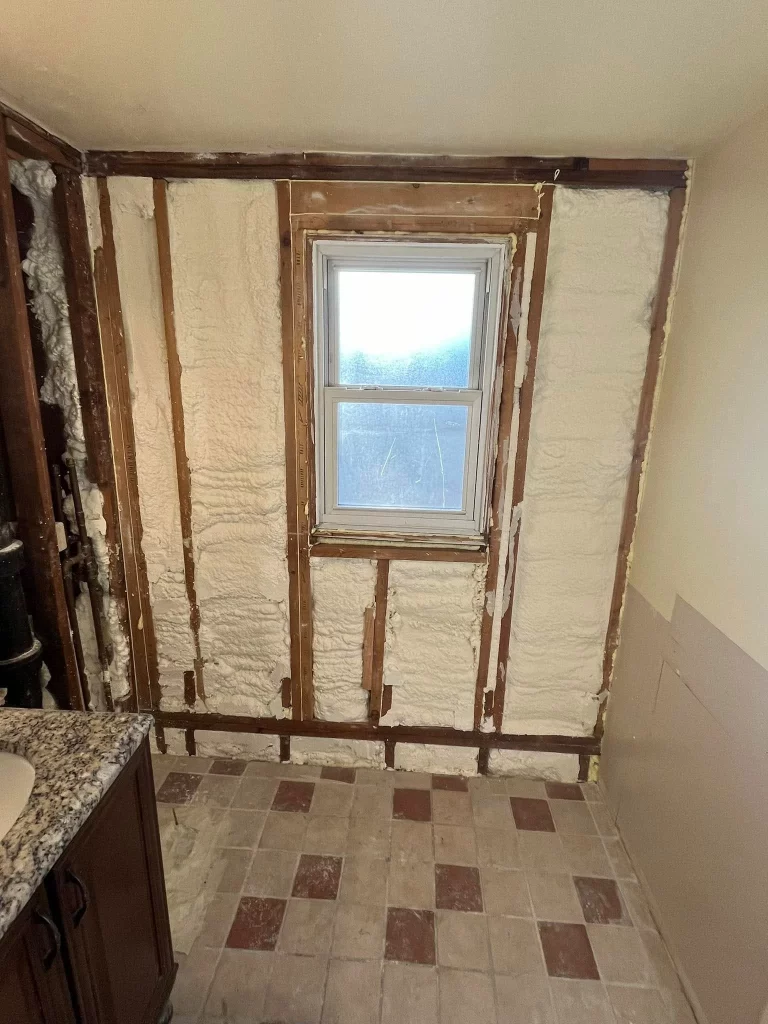
A pole barn has several distinct areas that each require a slightly different approach. Treating the building as a single insulation project without addressing each zone individually is a common mistake. Here are the five areas that demand attention, in rough order of priority.
Heat rises, which makes the ceiling your single largest source of energy loss in winter. In a pole barn with an open ceiling (no finished ceiling below the trusses), the roof itself becomes your thermal boundary. In a building with a finished ceiling, the attic floor becomes the boundary.
For an open-ceiling design, rigid foam board or spray foam applied directly to the underside of the roof decking creates an effective insulation layer. A radiant barrier or reflective insulation can also be installed directly under the metal roofing panels to reduce radiant heat gain in summer.
For a building with an attic, blown-in insulation on the attic floor is typically the most cost-effective approach. Target R-49 or higher for Climate Zone 5 compliance. If your trusses are scissor-style or otherwise limit attic depth, spray foam on the roof deck may be the better path.
Wall insulation is where you will notice the most immediate difference in comfort, especially during Bartlett’s cold winter winds. The wide spacing of pole barn girts (often 24 inches on center or wider) means fewer thermal bridges than conventional framing, which is actually an advantage.
The wall insulation strategy depends on what is covering the exterior. If you have metal panels, you need a method that addresses the condensation risk where warm interior air meets cold metal. This is where spray foam applied directly to the back of the metal, followed by cavity fill, truly shines.
Heat loss through the floor slab is often overlooked, but in a pole barn with a concrete floor, the slab edge is a significant thermal weak point. Installing rigid foam board insulation around the perimeter of the slab (at least 2 inches of XPS or EPS extending 2 feet down and 2 feet out from the edge) can dramatically reduce ground-coupled heat loss.
If you are pouring a new slab during construction, consider installing a continuous layer of rigid foam beneath the entire slab. For existing slabs, perimeter insulation alone makes a meaningful difference.
A well-insulated wall means nothing if you have single-pane windows and a drafty overhead door. Choose insulated garage doors with a minimum R-value of R-13.5 for any large openings. Entry doors should be steel or fiberglass with insulated cores and proper weather stripping. Windows should be double-pane with low-E glass and a good air leakage rating.
Air sealing around all door and window frames is critical. Gaps here are some of the largest sources of air infiltration in any building, and pole barns are no exception.
Expert Tip: We have seen pole barns with excellent wall and ceiling insulation that still felt drafty because the overhead door was a thin, uninsulated metal panel. If you only upgrade one thing in an existing pole barn, make it the largest door. The improvement is immediately noticeable.
While not technically an insulation material, the vapor barrier is so closely tied to insulation performance in pole barns that it deserves its own zone. We will cover this in detail in the next section, but the short version is this: without a properly placed vapor barrier, warm indoor air will condense against cold metal surfaces inside your wall cavities, soaking your insulation, promoting mold, and rotting your framing.
Key Takeaways: Five Insulation Zones
Whether you are insulating a new build or retrofitting an existing pole barn, following a systematic process ensures you do not miss critical steps. Here is the approach we use on every project.
Before buying any materials, evaluate your building’s current state. Walk through the interior and exterior, and ask yourself these questions:
If you find moisture damage or mold during your assessment, address those issues before adding any insulation. Insulating over existing moisture problems only makes them worse.
Air sealing should always come before insulation. If you skip this step, air moving through gaps and cracks will carry heat right past your insulation, rendering much of it ineffective. Air leakage can account for a significant portion of a building’s total heating and cooling energy consumption.
Use spray foam sealant or caulk to seal:
Pay special attention to the gap between the bottom of the wall girts and the top of the slab. This is a notorious air leakage point in pole barns.
In Bartlett’s climate, the vapor barrier goes on the interior (warm-in-winter) side of the insulation. This prevents warm, humid indoor air from migrating into the wall cavity and condensing against the cold metal exterior.
The most common approach is to use 6-mil polyethylene sheeting stapled to the interior side of the framing, with all seams overlapped and taped. Every penetration, seam, and joint must be sealed to create a continuous barrier. Any gap in the vapor barrier will allow moisture through, and even small amounts of condensation inside a closed wall cavity can cause big problems over time.
Expert Tip: If you choose closed-cell spray foam for your wall insulation, the foam itself can serve as your vapor barrier when applied at sufficient thickness (typically 1.5 inches or more). This simplifies the installation and eliminates the need for a separate polyethylene sheet. Not all foam products meet vapor barrier requirements at thin applications, so verify the manufacturer’s perm rating for the thickness you plan to install.
With air sealing complete and the vapor barrier in place, install your chosen wall insulation material into the cavities between the girts.
The approach here depends on whether your pole barn has a finished ceiling or an open design.
With an attic: If the building has a flat or conventional ceiling, the attic floor is your insulation plane. Blown-in cellulose or fiberglass is the most efficient and economical choice. Install insulation baffles at the eaves to maintain ventilation airflow from the soffit vents to the ridge vent. Then blow the insulation to your target depth, which for R-49 in Climate Zone 5 typically means 14 to 19 inches of blown cellulose or fiberglass.
Without an attic (open ceiling): If the interior is open to the roof, you need to insulate the roof plane itself. This is more challenging and more expensive, but necessary. Options include spray foam applied directly to the underside of the roof decking, rigid foam board installed between the roof purlins, or a combination of both. A radiant barrier under the metal roofing panels can supplement the insulation and significantly reduce summer heat gain.
For an existing slab, install rigid foam board vertically around the exposed perimeter. Dig down at least 2 feet along the edge of the slab if possible, attach the foam board to the vertical face, and backfill. For new construction, place a continuous layer of foam board under the entire slab before pouring concrete.
The foam board protects the slab edge from the worst of the ground frost and keeps the perimeter of your floor significantly warmer during winter.
Insulation reduces heat transfer, but it also reduces natural air exchange. Once your pole barn is insulated and air-sealed, you need a ventilation strategy to maintain indoor air quality and prevent moisture buildup.
For a pole barn used as a workshop or occasional-use space, ridge vents combined with soffit vents may provide sufficient passive ventilation. For a pole barn converted to a full-time living space, you will likely need mechanical ventilation such as an energy recovery ventilator (ERV) or exhaust fans paired with intentional fresh air intake.
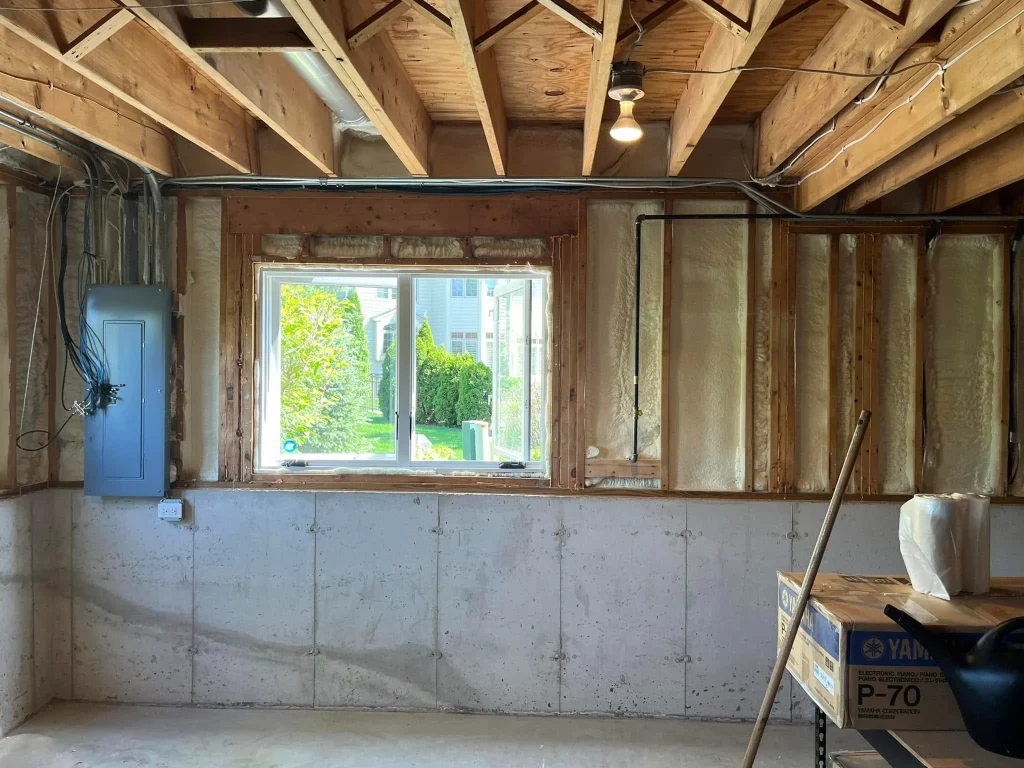
If there is one topic we could impress upon every pole barn owner, it would be this: moisture is the enemy. Condensation is the single most common and destructive problem we encounter in pole barn insulation projects.
Here is how it happens. During winter, the air inside your heated pole barn holds moisture from cooking, breathing, space heaters, and other sources. That warm, moist air migrates through the wall cavity toward the exterior. When it reaches the back of the cold metal siding, it condenses into liquid water. The same process happens at the roof. Warm interior air rises, hits the cold underside of the metal roof panels, and condenses.
The results are predictable and damaging:
This is why vapor barrier placement and material selection matter so much. A proper installation puts the vapor barrier on the warm side of the insulation to stop moisture-laden air before it can reach the cold metal surface. Spray foam applied directly to the metal eliminates the cold surface entirely from the interior perspective, which is why it is so effective at preventing condensation.
Expert Tip: Even with proper insulation and vapor barriers, avoid using unvented propane heaters in your pole barn. A single propane heater can produce gallons of water vapor per day, overwhelming even a well-designed moisture control system. If you must use temporary heating during construction, provide supplemental ventilation to exhaust the moisture.
After years of working on pole barn insulation projects in the greater Chicago area, we have seen the same mistakes repeated. Here are the ones that cause the most problems.
Skipping air sealing. Many homeowners focus entirely on stuffing insulation into cavities while ignoring the air leaks that allow heat to bypass it entirely. Air sealing should always be the first step.
Compressing fiberglass batts. Batts that are jammed into a cavity narrower than their rated width lose a substantial portion of their R-value. If the cavity is 3.5 inches wide, use a 3.5-inch batt, not a 5.5-inch batt forced into the space.
Placing the vapor barrier on the wrong side. In cold climates like Bartlett’s, the vapor barrier goes on the interior side. Placing it on the exterior side traps moisture inside the wall cavity, which is worse than having no vapor barrier at all.
Blocking soffit ventilation with attic insulation. When blowing insulation into an attic, the eave vents must remain clear for air to flow. Without adequate ventilation, moisture accumulates in the attic space and can cause roof sheathing to rot. Always install rafter baffles before adding blown insulation.
Ignoring the overhead door. An uninsulated 16-foot overhead door is essentially a giant hole in your insulated wall. If you invest in wall and ceiling insulation but leave the door as-is, you will still feel drafts and lose a tremendous amount of energy.
Using the wrong insulation for the conditions. Fiberglass is cheap, but it performs poorly in the high-condensation environment of a metal-sided building unless paired with an excellent air barrier and vapor retarder system. Sometimes spending more upfront on spray foam or rigid foam saves far more in avoided damage and energy costs over time.
If you are unsure whether your pole barn needs insulation or whether existing insulation is adequate, look for these indicators:
The cost of insulating a pole barn varies widely based on the size of the building, the insulation materials chosen, the complexity of the installation, and whether the building is new construction or a retrofit. Based on our project data in the greater Chicago area, typical pole barn insulation projects fall within the following ranges:
| Cost Factor | Details |
|---|---|
| Typical low project price | $8,000 |
| Typical average project price | $14,000 |
| Typical high project price | $22,000 |
Factors that tend to increase the cost include difficult access to insulation cavities, steep roof pitches, larger square footage, and higher R-value requirements. Factors that can help lower the cost include the building owner prepping the area before installation and straightforward access to all insulation zones.
While the upfront investment is significant, the long-term savings on heating and cooling costs, combined with the increased usability of the space and protection against moisture damage, make insulation one of the most practical improvements you can make to a pole barn in Bartlett.
Insulating a pole barn for year-round residential use in Bartlett is a project that rewards careful planning. Start by understanding your Climate Zone 5 requirements, then choose insulation materials that address both thermal performance and moisture control. Focus your efforts on the five key zones, prioritize air sealing before insulating, and never underestimate the damage that condensation can cause in a metal-sided building.
Whether you are planning a new build or retrofitting an existing structure, the principles are the same. Assess first, seal the gaps, install your vapor barrier on the warm side, insulate to the appropriate R-value, and ensure adequate ventilation. Follow that sequence and you will end up with a pole barn that stays comfortable through every Illinois season while keeping your energy costs under control.
Keep this guide handy as a reference throughout your project. Every pole barn is a little different, so adapt these recommendations to your specific building, and do not hesitate to bring in a professional when the project calls for it.
If you are planning to insulate a pole barn in Bartlett or the surrounding area and want professional guidance, we are here to help. You can reach our team at South Chicago Insulation by calling (779) 803-8025 or emailing [email protected]. We will walk through your building’s specific needs, discuss your options, and help you decide on the best approach for your situation.
Some aspects, like installing fiberglass batts or rigid foam board, are manageable for experienced DIYers. Spray foam insulation requires professional equipment and training and should always be installed by a certified contractor. Even with DIY-friendly materials, proper air sealing and vapor barrier installation are critical, and mistakes can lead to costly moisture damage.
For a typical residential pole barn in the 1,500 to 2,500 square foot range, a professional crew can usually complete the insulation work in two to four days, depending on the materials used and the complexity of the building. Spray foam projects are often faster than batt installations because the material goes up quickly, though curing time must be factored in.
Properly installed insulation with correct vapor barrier placement prevents condensation rather than causing it. The problems arise when insulation is added without addressing moisture control, or when the vapor barrier is placed on the wrong side of the wall assembly. If your building already has condensation issues, those must be diagnosed and resolved as part of the insulation project.
Permit requirements depend on the scope of work and how your local jurisdiction classifies the building. If the pole barn is being converted to habitable living space, permits and inspections are almost certainly required. For workshop or storage use, requirements vary. We always recommend checking with the Bartlett building department before starting any insulation project.
For Climate Zone 5, the code minimum for wood-frame walls is R-20 (or R-13 cavity insulation plus R-5 continuous sheathing). We typically recommend aiming for R-21 or higher in pole barn walls to account for the thermal bridging that occurs at girts and posts. This provides a meaningful buffer above code minimums and noticeably better comfort.
If the interior walls are already finished with drywall or paneling, your options are more limited. Blown-in insulation through small holes drilled in the wall facing is one approach. Dense-pack cellulose or fiberglass can be installed this way. Removing and replacing interior finishes gives you access to the full cavity for better material choices and more thorough air sealing.