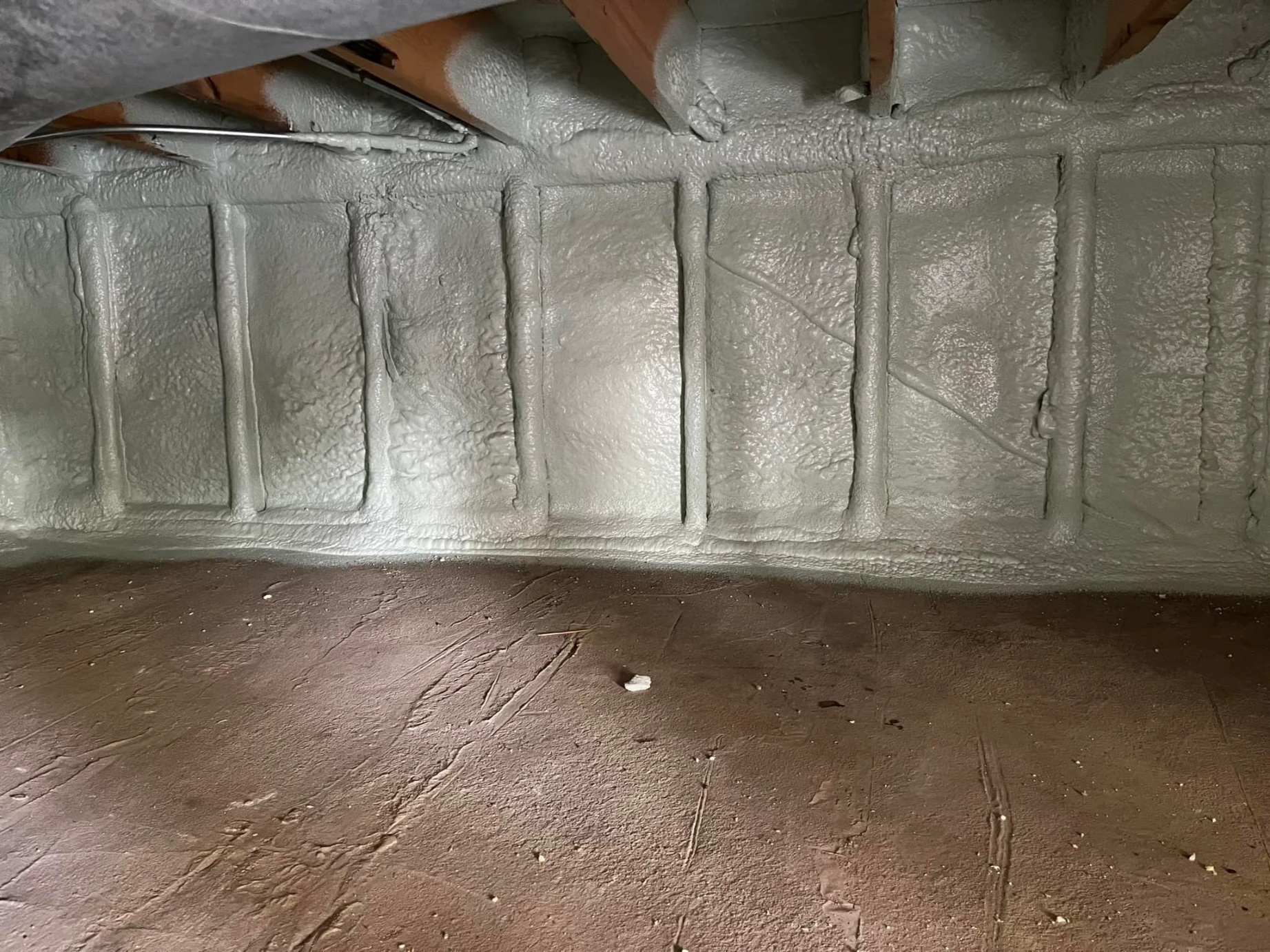
How open-cell spray foam reduces the transfer of voices between rooms
admin_southchica
November 27th, 2025
Open-cell spray foam insulation is highly effective at reducing the transfer of airborne sound, such as human voices, primarily because of its unique physical structure. The foam is soft, lightweight, and filled with millions of interconnected air pockets, which function as sound absorbers. When voice waves enter a wall cavity filled with this material, the energy of the sound waves dissipates as they travel through the spongy, open structure, reducing the intensity before it can pass into the adjacent room. This mechanism focuses on absorption rather than simply blocking the sound.
While traditional building materials like drywall rely on mass to block sound, open cell foam’s primary strength lies in its high Noise Reduction Coefficient (NRC). This coefficient measures how much sound energy an object absorbs rather than reflects. For common mid-to-high frequency sounds like speech, this absorptive quality makes open cell foam a top-tier choice for interior wall and ceiling acoustic treatments, especially in residential and office settings where minimizing conversational noise is important.
Effective acoustic treatment requires understanding sound isolation and selecting materials that target specific frequencies. Since voices fall into a specific mid-range frequency band, choosing a material optimized for that range is essential. For typical residential noise issues, like voices, open cell foam proves consistently beneficial because its structure is designed to dampen those exact frequencies.
Understanding Sound Transmission Class and Noise Reduction
To understand sound isolation, two metrics are most commonly used: Sound Transmission Class (STC) and Noise Reduction Coefficient (NRC). The STC rating measures how well a building partition blocks airborne sound, while the NRC measures how much sound the material absorbs. Open cell foam typically performs very well on the NRC scale, often achieving values above 0.80, meaning it absorbs 80% of the sound energy hitting it, according to analysis from the Acoustical Society of America.
Voice frequencies generally fall between 250 Hz and 2000 Hz. This mid-range frequency is readily captured and dampened by the cellular structure of open cell polyurethane foam. This process minimizes the sound energy that reaches the other side of the partition. For comparison, low-frequency sounds like heavy bass or mechanical vibrations require high mass or decoupling techniques, areas where open cell foam is less specialized.
Bonus Tip: To maximize voice reduction in interior walls, contractors recommend ensuring the wall cavity is 100% filled, eliminating any air gaps or voids where sound can sneak around the foam. Even small gaps significantly compromise overall acoustic performance.
Comparison of Insulation Types for Noise Reduction
When evaluating acoustic control options, it helps to compare open cell foam against other common insulation materials. While the STC rating is often discussed, the NRC rating is a more reliable predictor of how well a material handles conversational noise. For context, open cell foam generally carries an STC rating in the mid-30s to low-40s in a standard 2×4 wall assembly, comparable to or slightly better than fiberglass, but its absorptive qualities are what truly set it apart.
Material Type
Primary Mechanism
Typical NRC Range
Typical STC in 2×4 Wall
Best Use Case for Sound
Open Cell Foam
Absorption/Air Sealing
0.70 – 0.90
37 – 42
Conversational Noise (Voices)
Closed Cell Foam
Blocking/Mass
0.10 – 0.20
38 – 45
Air and Vapor Barrier
Fiberglass Batts
Absorption/Friction
0.60 – 0.85
35 – 39
General Thermal and Acoustic Fill
The U.S. Census Bureau data shows that residential construction continues to prioritize speed and thermal efficiency, often overlooking acoustic concerns. Integrating open cell foam early in the building phase is a cost-effective way to address sound isolation needs that are increasingly relevant in higher-density housing or home offices.
Installation Factors Affecting Voice Isolation
Achieving the desired sound reduction relies heavily on proper installation. Since open cell foam is applied as a liquid and expands to fill the entire cavity, it creates an airtight seal that eliminates sound paths. This continuous barrier is crucial because sound, like air, follows the path of least resistance.
Flanking Paths and Assembly Gaps
Sound often travels around, rather than through, a partition. These bypasses are called flanking paths. Common flanking paths include ceiling plenum spaces, electrical outlets, and ventilation ducts. Even perfectly applied foam will fail to isolate sound if these paths are ignored. Effective sound isolation requires addressing the entire wall assembly, including sealing around all penetrations, before the drywall goes up.
Bonus Tip: Remember that effective sound control requires sealing all air leaks. Utilizing open cell foam minimizes air transfer, which simultaneously addresses thermal performance and acoustic damping. This dual function makes it a practical solution for improving both comfort and energy savings, especially in regions with varied climate conditions like the greater Chicago area.
Things to Consider Before Making a Decision
Effective acoustic isolation begins with careful planning. Before specifying open cell foam, property owners need to clearly define the exact needs and performance goals for the space. Treating a shared wall between a bedroom and a busy living space, for example, requires different technical preparation than treating an internal office wall.
Desired Decibel Reduction
Determine the level of silence required. Are you trying to achieve a significant reduction in noticeable speech (STC 50+) or simply trying to muffle conversations? For high-performance soundproofing, open cell foam should be coupled with additional mass, like layers of drywall or specialty acoustic paneling.
Wall Assembly Details
Review the existing or planned wall structure. Sound isolation improves dramatically when the wall is constructed with staggered studs or resilient channels, which physically decouple the two sides of the partition. Open cell foam works best when applied within an already well-designed acoustic assembly.
Budget and Scope
Open cell spray foam is generally more expensive than fiberglass batts but offers superior performance in air sealing and absorption. Balancing the budget against the required acoustic performance is essential. A study by the National Institute of Standards and Technology confirms that even minor improvements in air tightness (a benefit inherent to spray foam) lead to measurable increases in the effective STC rating of a wall assembly.
Selecting the Right Strategy
Choosing open cell foam for noise reduction is choosing a strategy focused on absorption and air sealing. For conversational noise and general residential quietness, it is an excellent material that delivers strong results by eliminating air pathways and dampening airborne sound energy. Evaluating the specific noise issues and designing the overall wall assembly correctly will ensure the long-term effectiveness of the acoustic treatment.
Need to Know More About Sound Isolation
If seeking expert advice on integrating high-performance acoustic insulation into a new build or renovation, connect with South Chicago Insulation. The team provides detailed consultations on material selection and application techniques tailored to specific project needs. Reach out via email at [email protected] or call (779) 803-8025 to discuss options for reducing unwanted sound transfer in your property.
Frequently Asked Questions
How does foam prevent flanking sound?
It does not prevent sound from traveling around the wall assembly, which is the definition of flanking sound. Open cell foam seals gaps within the wall cavity and around penetrations, which prevents sound from leaking through the partition itself. Addressing flanking paths requires treatments outside the foam, such as acoustically caulking the perimeter of the drywall.
Can open cell foam stop heavy foot traffic noise?
Noise from foot traffic is generally structure-borne sound, meaning the vibration travels through the physical components of the floor or ceiling assembly. While foam can slightly dampen the vibration, it is not the primary solution. Decoupling the floor or ceiling structure and using specialized mass-loaded vinyl or floor underlayment are typically more effective.
What is the maximum STC rating achieved solely with open cell foam?
In a typical residential wood-frame assembly, open cell foam alone generally limits the STC rating to the low 40s. To reach higher ratings (e.g., STC 50 or above, often required for professional studios or adjacent apartment units), the foam must be paired with additional measures like double layers of drywall, resilient clips, or staggered studs.
Should I worry about moisture affecting the foam’s acoustic performance?
Excessive moisture intrusion can compromise any insulation material. However, open cell foam maintains its structural integrity and acoustic absorption properties under normal operating conditions. If the foam becomes completely saturated due to a leak, its acoustic and thermal performance will be degraded until it dries out.
Sources
Acoustical Society of America – FAQ page detailing basic acoustic measurements and material properties like NRC and STC.
U.S. Census Bureau – Official government data providing context on residential construction trends and material adoption.
National Institute of Standards and Technology – Technical publication focusing on the relationship between air sealing, air tightness, and measured Sound Transmission Class in building assemblies.
Open-cell spray foam insulation in Burr Ridge, IL, presents significant problems primarily related to moisture management, structural suitability, and long-term…
Poor insulation in cold rooms directly causes significant operational problems, including temperature instability, excessive energy consumption, equipment strain, and product…