
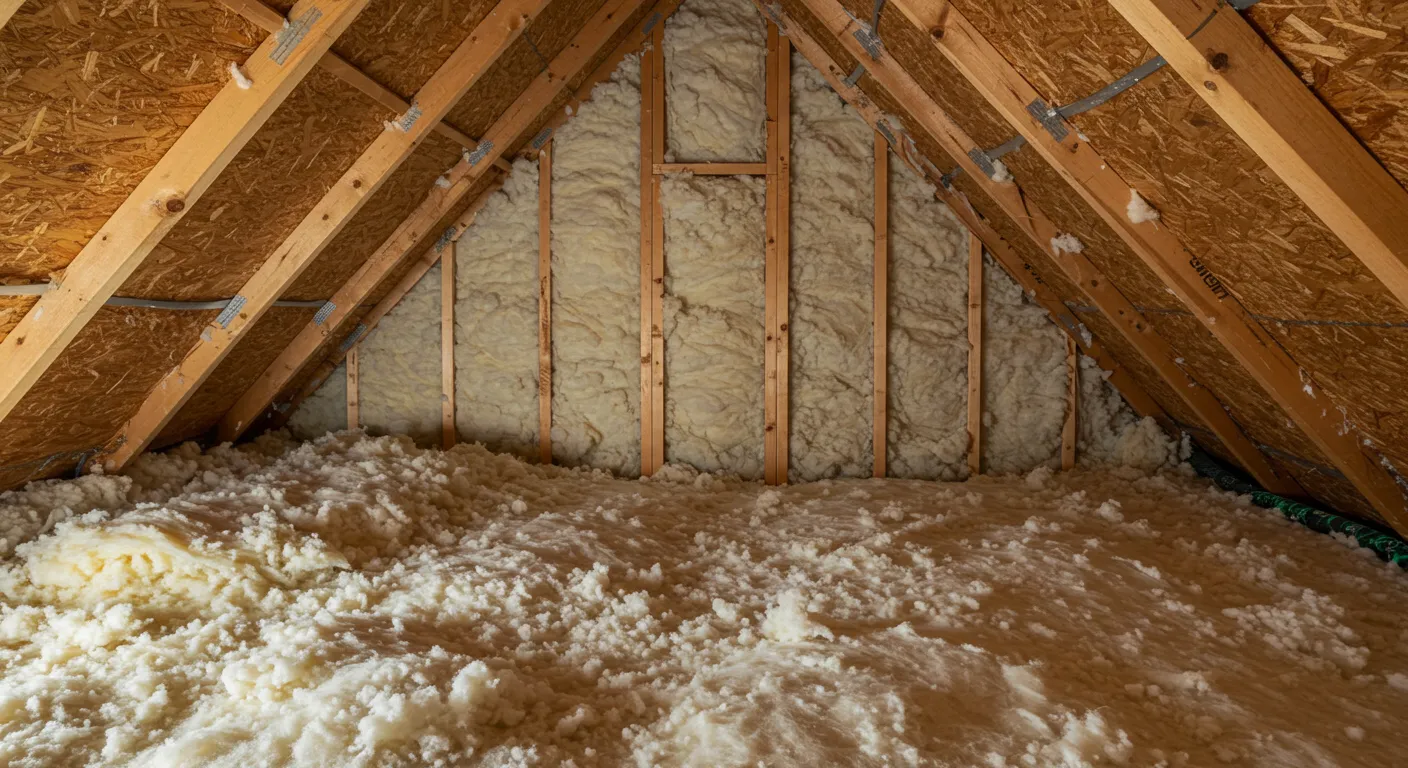
Blown-In Insulation in New Lenox, IL can be a practical option when an attic or wall assembly needs additional insulation, especially where loose-fill material can cover irregular spaces and areas that are difficult to reach with batts. The U.S. Department of Energy notes that loose-fill insulation such as cellulose and fiberglass conforms well to irregular cavities and attics with wires, ducts, and pipes. U.S. Department of Energy Building Science Education
For an existing attic, insulation should not be treated as the only step. Air sealing, moisture issues, ventilation, existing insulation condition, and the required insulation level all need to be considered before adding more material.
Blown-In Insulation Services New Lenox, IL can make sense when an existing attic has thin, uneven, or missing insulation. Loose-fill insulation is particularly useful where framing, wiring, ductwork, and other obstructions make it difficult to achieve consistent coverage with rigid or batt products. The U.S. Department of Energy describes blown fiberglass and cellulose as options for walls, ceilings, and attics. U.S. Department of Energy Building Science Education
The goal is not simply to put more material in the attic. The insulation needs to form a reasonably continuous thermal layer, while air leaks and moisture problems should be addressed separately. That distinction matters because adding insulation over an unresolved roof leak, poor ventilation condition, or major air leakage problem can leave the underlying issue untouched.
For homeowners considering a Blown-In Insulation Contractor New Lenox, IL, the first useful question is therefore not "How much insulation can we add?" It is "What is limiting the home's thermal performance right now?"
New Lenox is in Will County, where the county's hazard mitigation plan describes the local climate as humid continental, with hot summers and cold winters. It also identifies cold, dry air from Canada in winter and warm, humid air from the Gulf of Mexico during summer as important influences on the area's weather. Will County Emergency Management Agency
Regional 1991-2020 climate normals from the National Weather Service show the Chicago area averaging a January high of 31.6°F and low of 18.8°F, compared with a July high of 84.5°F and low of 66.4°F. The same dataset records 37.86 inches of annual precipitation and 38.4 inches of annual snowfall. These are Chicago normals rather than a New Lenox-specific station dataset, so they should be treated as regional context rather than exact New Lenox measurements. National Weather Service Chicago Climate Normals
A Blown-In Insulation Installation in New Lenox, IL project should start with an inspection rather than a predetermined amount of insulation.
We look at the existing material, coverage, access, visible moisture problems, and areas where air can move between the house and attic. ENERGY STAR recommends addressing attic air sealing before completing an attic insulation project and identifies wet insulation, mold or rot, inadequate ventilation, difficult access, and certain older wiring conditions as reasons to address problems before proceeding. ENERGY STAR
Existing insulation also does not automatically have to be removed. If it is dry and otherwise suitable, adding compatible loose-fill insulation may be an option. The correct approach depends on the condition of the existing assembly.
For Residential Blown-In Insulation in New Lenox, IL, homeowners should also think about future attic access. Blown insulation can make walking or finding components in an attic more difficult, so access paths and service areas should be planned rather than covered without consideration.
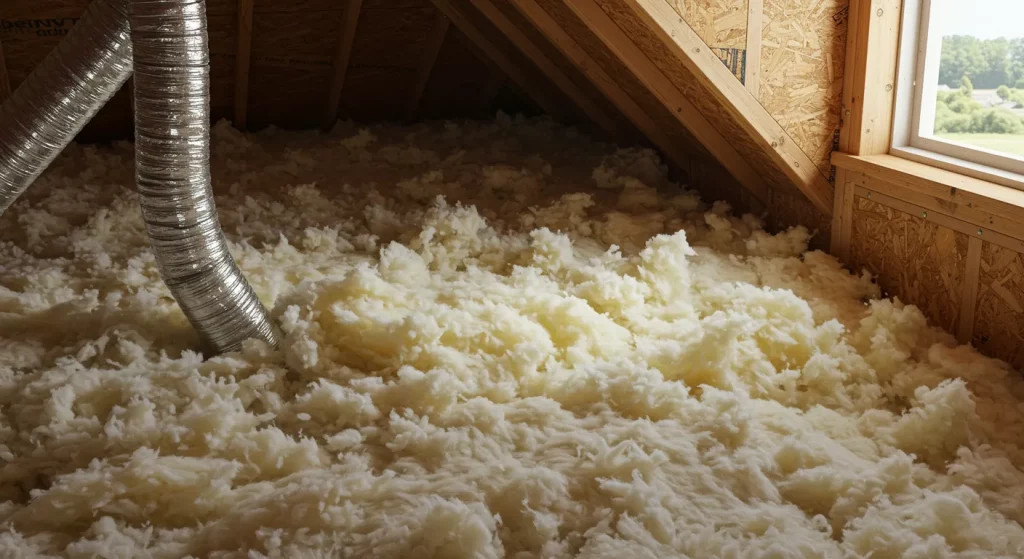
Blown-In Insulation Company in New Lenox, IL projects can involve different materials and applications. Cellulose and fiberglass are both used as loose-fill insulation, but the right material depends on the building assembly, existing insulation, installation requirements, and project goals.
The U.S. Department of Energy explains that insulation performance is expressed through R-value, which relates to resistance to heat transfer. It also emphasizes that insulation and air sealing work together as parts of a building's thermal envelope. U.S. Department of Energy Building Science Education
That is why we would not recommend choosing a material based only on its label or a promised energy-saving figure. The condition of the attic, the location of the insulation, the required code level, and the quality of installation all matter.
With Blown-In Insulation for Energy Efficiency in New Lenox, IL, the process should be based on the home's existing conditions.
A typical project starts with an assessment of the insulation and areas that need attention. If air leaks or moisture problems are found, those issues should be addressed before insulation is added. The loose-fill material can then be distributed across the intended area to create more consistent coverage.
For an existing vented attic, the Department of Energy's Building Science Education guidance says blown insulation should be installed after air sealing and should meet or exceed the levels required by the applicable building code. It also notes that baffles help maintain ventilation and keep insulation from falling into the eaves. U.S. Department of Energy Building Science Education
The finished result should be more than a thicker layer of insulation. It should be an attic assembly where insulation coverage, air sealing, ventilation, and moisture conditions have been considered together.
Blown-In Insulation for Home Comfort in New Lenox, IL may be worth investigating when rooms feel difficult to keep comfortable, an attic has visibly uneven insulation, or an older home has areas with limited insulation coverage.
It is also worth investigating before automatically replacing all existing insulation. A professional assessment can help determine whether the better solution is adding insulation, removing damaged material, improving air sealing, or addressing another building issue first.
South Chicago Insulation, LLC provides insulation services from our New Lenox location, including residential insulation, attic insulation, blown-in cellulose insulation, retrofit insulation, and air sealing.
If you're comparing Blown-In Insulation Installation New Lenox, IL options, we can evaluate the existing conditions and discuss what makes sense for your home rather than treating every attic the same way. Call (779) 803-8025 or email [email protected] to discuss your insulation project.
Yes, blown-in insulation can be installed around many existing attic obstructions, which is one reason loose-fill insulation can work well in retrofit projects. However, the condition and type of wiring, fixtures, ducts, and other components should be assessed before installation.
Blown-in insulation does not have a simple expiration date. Its useful performance depends on factors such as the material, installation quality, moisture exposure, settling, and whether the insulation remains properly distributed. An inspection can help determine whether existing insulation still performs adequately.
It can help when temperature differences are related to inadequate insulation or heat transfer through an attic or other insulated assembly. However, uneven temperatures can have several causes, including air leakage, ductwork problems, windows, or HVAC distribution, so insulation should not automatically be assumed to be the only issue.
It can be suitable for many existing homes, but older construction can require additional inspection before insulation work begins. Existing wiring, previous insulation, moisture conditions, attic ventilation, and the building assembly should be considered before selecting an installation approach.
Visible gaps, uneven coverage, damaged or wet insulation, exposed attic areas, and noticeable temperature differences can be reasons to have the attic evaluated. A professional inspection can provide more useful information than judging insulation needs only by its appearance.